Who We Are
The American Petroleum Institute (API) represents all segments of America’s natural gas and oil industry, which supports nearly 11 million U.S. jobs and is backed by a growing grassroots movement of millions of Americans. Our approximately 600 members produce, process and distribute the majority of the nation’s energy. API was formed in 1919 as a standards-setting organization and has developed more than 800 standards to enhance operational and environmental safety, efficiency and sustainability.
What We Do
API’s mission is to promote safety across the industry globally and to influence public policy in support of a strong, viable U.S. oil and natural gas industry.
-
Policy Advocacy: API is the leading voice of the natural gas and oil industry—engaging with Congress, the Executive Branch, state and local governments, regulatory agencies, courts, the media, and the public to promote informed, balanced energy policies.
-
Standards & Certification: API has developed more than 800 standards and recommended practices to promote safe, interoperable, and environmentally sound operations. API Global Standards are the base for API’s Certification Programs and are developed to assist industry professionals improve the efficiency and cost effectiveness of their operations and comply with legislative and regulatory requirements.
-
Research & Statistics: API collects, maintains and publishes research and statistics on all aspects of U.S. industry operations, including supply and demand for various products, imports and exports, drilling activities and costs, and well completions. API’s Weekly Statistical Bulletin is the most recognized publication, widely reported by the media.
API Principles
We are the problem-solvers who tackle the world’s greatest energy challenges—meeting growing demand, fueling economic growth and creating a better tomorrow.
To fulfill this responsibility, our members uphold the following principles:
- Advance safe and responsible U.S. petroleum and natural gas production, transportation, refining, marketing and use, and lead the world in meeting the growing demand for affordable, reliable and ever cleaner energy.
- Continually reduce environmental impacts and improve the health and safety of our employees, operations and communities.
- Commit to enhance the integrity of operations across the industry by applying API’s standards, implementing workforce training programs, and participating in performance initiatives.
- Promote free markets and free trade as the cornerstone of our industry’s efforts to compete and innovate to address current and future energy needs.
- Support risk-based, cost-effective government regulation and other policies that address critical challenges for industry and set industry-wide standards which promote U.S. innovation, investment and international competitiveness.
- Commit to hiring, training and developing a highly skilled and diverse workforce.
To advance our members’ goals, API:
- Commits to be transparent and accountable to members, customers and employees regarding how decisions are made, priorities are set and performance is assessed.
- Emphasizes agility and responsiveness in meeting near-term challenges, while pursuing long-term value-creation and competitiveness for our industry, supported by science, data and analysis.
- Maintains a safe, inclusive work environment that is enriched by diversity and values open communication, collaboration, hard work, respect and adherence to the highest ethical standards.
- Partners with other organizations where appropriate to leverage individual strengths and drive the best outcomes for the natural gas and oil industry.
Our Origins
The American Petroleum Institute traces its beginning to World War I, when Congress and the domestic natural gas and oil industry worked together to help the war effort.
At the time, the industry included the companies created in 1911 after the court-imposed dissolution of Standard Oil and the "independents", companies that had been "independent" of Standard Oil. They had no experience working together, but they agreed to work with the government to ensure that vital petroleum supplies were rapidly and efficiently deployed to the armed forces.
The National Petroleum War Service Committee, which oversaw this effort, was initially formed under the U.S. Chamber of Commerce and subsequently as a quasi-governmental body.
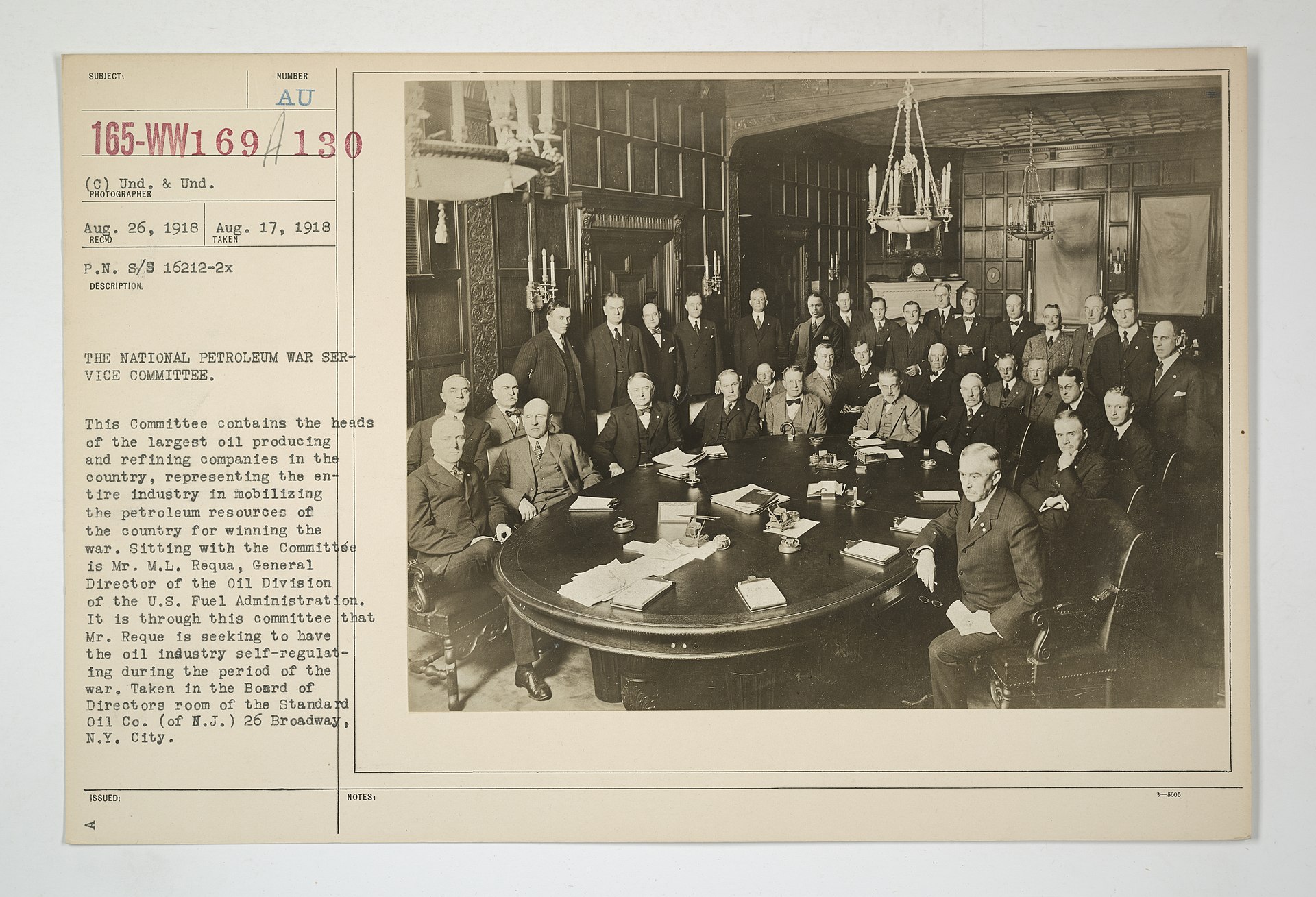
The National Petroleum War Service Committee
After the war, momentum began to build to form a national association that could represent the entire industry in the postwar years. The industry’s efforts to supply fuel during World War I not only highlighted the importance of the industry to the country, but also its obligation to the public, as the original charter demonstrates.
The American Petroleum Institute was established on March 20, 1919:
- to afford a means of cooperation with the government in all matters of national concern
- to foster foreign and domestic trade in American petroleum products
- to promote in general the interests of the petroleum industry in all its branches
- to promote the mutual improvement of its members and the study of the arts and sciences connected with the natural gas and oil industry
Modern Origins
In late 1969, API made the decision to move its offices to Washington, D.C. where we remain today.
API is the only national trade association representing all facets of the natural gas and oil industry, which supports 10.3 million U.S. jobs and nearly 8 percent of the U.S. economy. API’s more than 600 members include large integrated companies, as well as exploration and production, refining, marketing, pipeline, and marine businesses, and service and supply firms. They provide most of the nation’s energy and are backed by a growing grassroots movement of more than 47 million Americans.
In one generation, the United States has gone from steadily growing energy dependency to a nation that’s largely in control of its energy destiny. Natural gas and oil now drive the U.S. and world economies, and energy analysts project they will continue in that leading role for decades to come. This industry is changing our country’s narrative and altering its trajectory in historic terms, supplying the foundation for modern life and providing the fuel, power and products that make everyday life safer, healthier and more comfortable.
America’s natural gas and oil industry not only creates jobs, but also lifts entire communities, revitalizes manufacturing, strengthens U.S. security and develops the technology of the future; all while leading the charge in solving complex challenges.
That’s why the United States leads the world in both producing natural gas and oil, and in reducing greenhouse gas emissions. The old paradigm of energy and economic growth interlocked with increased emissions has been replaced. Today, growth and decreased emissions have occurred together. U.S. carbon dioxide emissions have plunged to their lowest level in a generation, while CO2 emissions around the globe have risen 50 percent since 1990.
This is where we are today. We are freer and more secure as a nation, able to plan for an optimistic future and global leadership because of abundant, secure domestic natural gas and oil.


